
Grouting looks like a small step in the construction process — a gap filled, a base plate leveled, a joint sealed. But get it wrong, and the consequences can range from unsightly cracks to full structural failure. In fact, several documented structural collapses have been traced directly back to grouting that wasn’t placed correctly at load-bearing points. This guide walks through the most common grouting problems in construction, why they happen, and how choosing the right structural grout — like Evergreen’s Ever Power Grout range — helps you avoid them altogether.
Why Grouting Problems Deserve More Attention on Site
Structural grout isn’t just a filler — it transfers load, resists vibration, and protects against moisture and corrosion at critical structural junctions like column bases, machine foundations, and beam supports. When grouting fails, the problem is often invisible until it’s too late, making prevention far more important than after-the-fact repair.
Ready Mix Cement Plaster vs Traditional Plaster: How They Compare
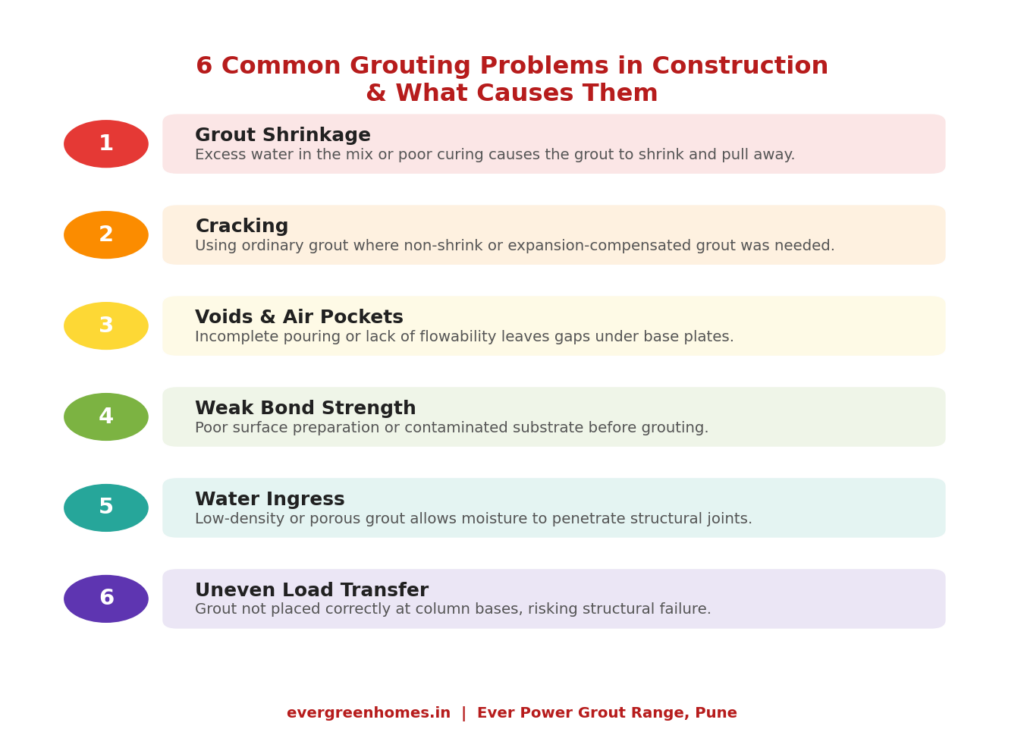
1. Grout Shrinkage
Shrinkage is one of the most frequent grouting problems in construction. It typically happens when too much water is added to the mix, or when the grout isn’t cured properly. As the grout dries, it pulls away from the surrounding surface, creating gaps that compromise load transfer and let moisture in.
How to Avoid It
Use a non-shrink structural grout formulated to compensate for shrinkage, follow the manufacturer’s exact water-to-powder ratio, and maintain proper curing conditions for at least 24-72 hours.
2. Cracking
Cracking often results from using an ordinary cementitious mix when an expansion-compensated or non-shrink grout is required. Temperature fluctuations on-site can also accelerate cracking if the grout isn’t formulated to handle thermal movement.
How to Avoid It
Always match the grout type to the application — heavy machinery bases and structural columns need a high-performance, non-shrink grout designed for those specific loads.
3. Voids and Air Pockets
Voids form when the grout doesn’t fully flow into every gap beneath a base plate, often due to poor flowability or rushed pouring. These hidden air pockets weaken the structure and are a leading cause of uneven load transfer.
How to Avoid It
Choose a free-flowing grout with high flowability, pour from one side continuously, and use vibration or rodding techniques where recommended to eliminate trapped air.
4. Weak Bond Strength
Poor surface preparation — dust, oil, loose debris, or an insufficiently roughened substrate — is one of the most avoidable grouting problems in construction. A weak bond compromises the entire purpose of the grout: transferring load between two surfaces.
How to Avoid It
Thoroughly clean and, where needed, pre-wet the substrate before grouting. Never grout over a contaminated or dry, dusty surface.
5. Water Ingress
Low-density or porous grout allows water to penetrate structural joints over time, leading to corrosion of embedded reinforcement and long-term structural damage — especially in below-grade or exposed applications.
How to Avoid It
Use a dense, low-permeability structural grout with proven water resistance, particularly for foundations, basements, and exposed structural elements.
6. Uneven Load Transfer
This is the most serious of all grout problems in construction. When grout isn’t placed correctly — or at all — at critical points like the base of a column, the load isn’t transferred evenly to the footing below. Over time, this can lead to catastrophic structural failure.
Choosing the Right Grout: Evergreen's Ever Power Grout Range
Most grouting problems in construction trace back to one root cause: using the wrong grout for the job. Evergreen’s Ever Power Grout range is engineered specifically to prevent shrinkage, cracking, voids, and weak bonding across a range of structural applications.
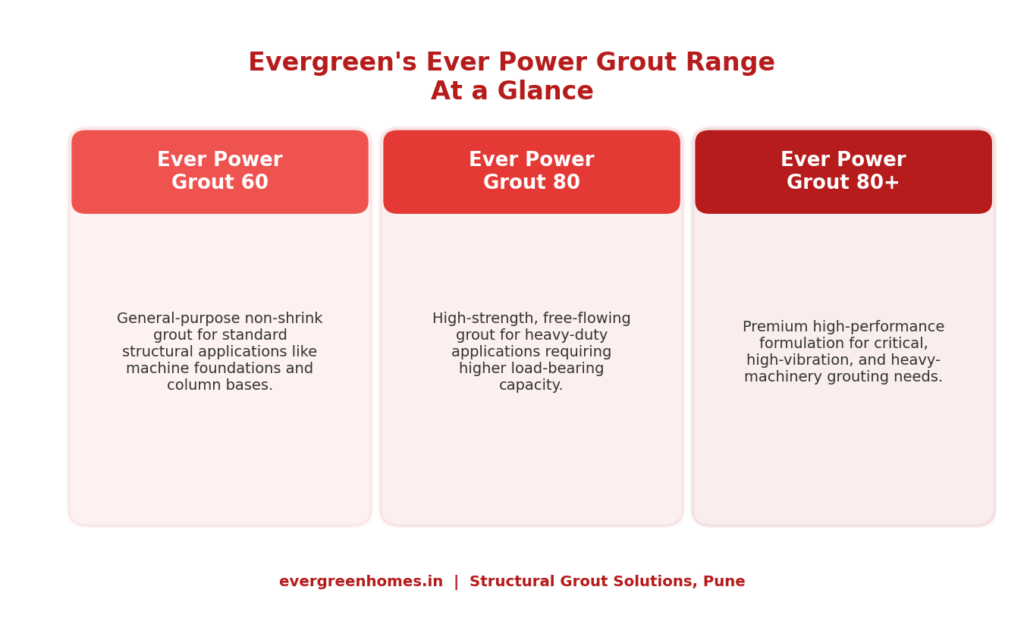
Ever Power Grout 60
A reliable, general-purpose non-shrink grout suited for standard structural applications such as column bases, machine foundations, and general load-bearing joints — ideal where consistent strength and ease of application matter most.
Ever Power Grout 80
A high-strength, free-flowing formulation designed for heavy-duty applications that demand higher load-bearing capacity, such as larger machine foundations, structural bearings, and precast connections.
Ever Power Grout 80+
Evergreen’s premium high-performance grout, built for critical, high-vibration, and heavy-machinery grouting needs where maximum strength, durability, and long-term reliability are non-negotiable.
Frequently Asked Questions
What is the most common cause of grout failure?
Incorrect water-to-powder ratio and poor curing are the leading causes of grout shrinkage and cracking on most construction sites.
Can ordinary cement mortar be used instead of structural grout?
No — ordinary mortar lacks the non-shrink properties, flowability, and compressive strength required for structural applications like column bases and machine foundations.
How do I choose between Ever Power Grout 60, 80, and 80+?
The right choice depends on your project’s load requirements — Grout 60 for standard applications, Grout 80 for heavy-duty needs, and Grout 80+ for critical, high-vibration installations.
Build on a Stronger Foundation with Evergreen Enterprises
Don’t let a preventable grouting problem compromise your project’s structural integrity. Evergreen’s Ever Power Grout 60, 80, and 80+ are trusted by contractors across Pune for consistent strength, non-shrink performance, and long-term durability.
📞 Contact us today at 7768996699 / 7768993399 or visit our Structural Grout page to find the right grade for your project.