
Walk onto any Indian construction site and you’ll find the same debate happening between masons, contractors, and homeowners: should tiles be fixed with old-school cement mortar, or the newer tile adhesive? The answer isn’t one-size-fits-all — it depends on the tile type, the surface, and where in the home you’re tiling. This guide breaks down the tile adhesive vs cement question in detail so you can make the right call for your project.
What Is Cement Mortar for Tile Fixing?
Cement mortar for tiling is a traditional, site-mixed combination of Ordinary Portland Cement (OPC), sand, and water, typically blended in a 1:4 or 1:5 ratio. It’s been the default tile-fixing method in Indian homes for decades, largely because the materials are cheap, widely available, and familiar to most masons.
Limitations of Cement Mortar
-
Lower bond strength compared to polymer-modified adhesives
-
Prone to cracking and ‘lippage’ (uneven tile edges) due to fast, uneven setting
-
Poor water resistance, risky for bathrooms, kitchens, and balconies
-
Requires a thicker application layer, adding weight and material cost
-
Longer curing time — often 24–48 hours before the surface can bear load
What Is Tile Adhesive?
Tile adhesive is a factory-manufactured, polymer-modified bonding compound designed specifically for fixing tiles. It comes as a ready-to-mix powder — just add water — and is engineered to deliver stronger adhesion, better flexibility, and improved water resistance than traditional mortar.
Advantages of Tile Adhesive
-
Up to several times higher bond (shear) strength than cement mortar
-
Thin-bed application (3-6mm), reducing material use and added floor weight
-
Longer ‘open time’, giving masons room to adjust tile alignment before it sets
-
Excellent for large-format, vitrified, and low-porosity tiles
-
Water and crack resistant — ideal for wet areas and exteriors
Tile Adhesive vs Cement: Head-to-Head Comparison
1. Bond Strength
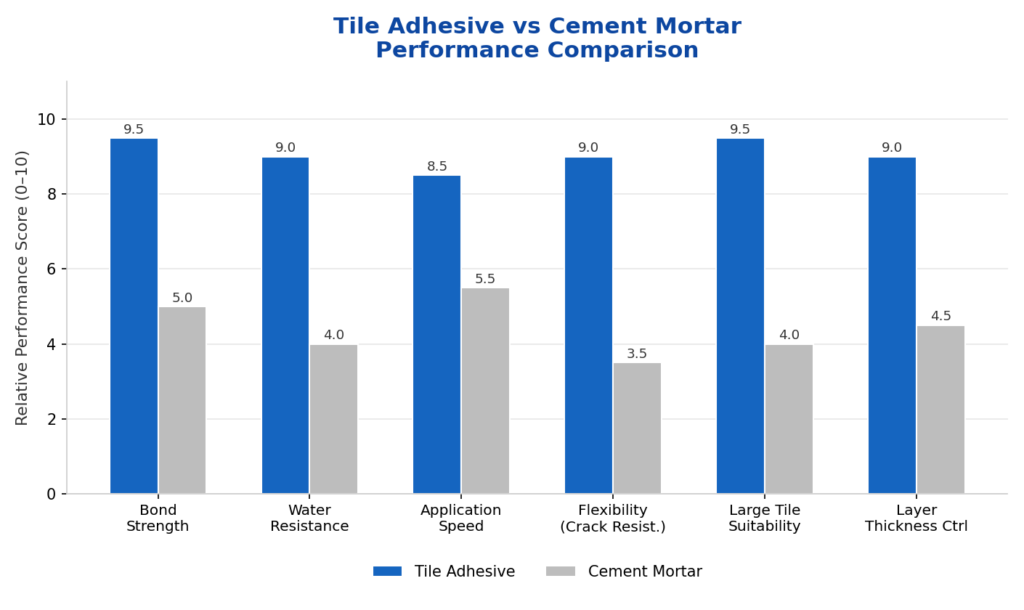
This is the most decisive factor. Cement mortar relies mostly on the tile’s weight and surface texture to hold, while polymer-modified tile adhesive chemically bonds to the substrate — delivering dramatically stronger adhesion, especially critical for today’s dense, low-porosity vitrified and porcelain tiles.
2. Water Resistance
Cement mortar is porous and absorbs moisture over time, which can weaken the bond in wet areas. Tile adhesive is formulated with water-repellent additives, making it the safer choice for bathrooms, kitchens, balconies, and swimming pool tiling.
3. Application Speed and Ease
Cement mortar sets quickly and unevenly, often causing lippage if masons aren’t fast and precise. Tile adhesive has a longer, more controlled open time, allowing for better alignment and a flatter, more professional finish.
4. Cost Comparison
Cement mortar looks cheaper upfront, but it needs a thicker layer and more material overall, plus more labor time. Tile adhesive costs more per bag but is applied in a thin layer, so on larger projects, the total installed cost often ends up comparable — while delivering a stronger, longer-lasting result.
5. Suitability by Tile Type
-
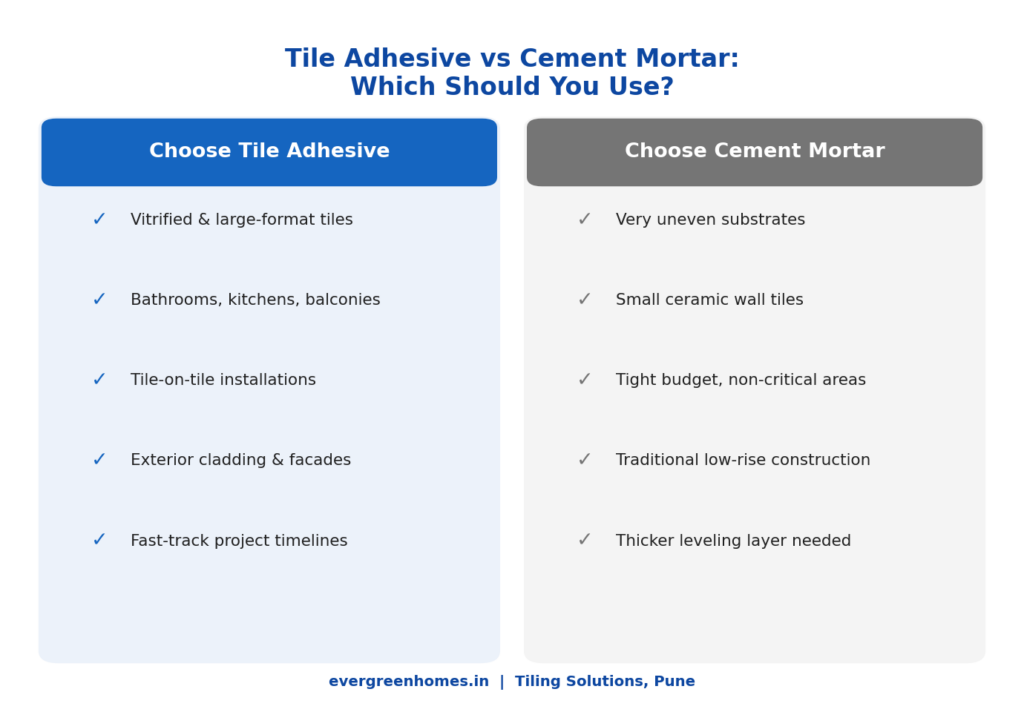
Small ceramic wall tiles on flat surfaces: cement mortar can work adequately
-
Vitrified, porcelain, and large-format tiles: tile adhesive is strongly recommended
-
Natural stone and glass tiles: tile adhesive prevents staining and ensures secure bonding
-
Tile-over-tile renovation: only tile adhesive is suitable, since mortar won’t bond well to an existing tiled surface
Frequently Asked Questions
Can I use cement mortar for vitrified tiles?
It’s not recommended. Vitrified tiles have very low porosity, and cement mortar struggles to form a strong mechanical bond with them, increasing the risk of hollow sounds and tile detachment over time.
Is tile adhesive worth the extra cost for a small bathroom renovation?
Yes — bathrooms face constant water exposure, and the stronger, water-resistant bond of tile adhesive significantly reduces the risk of future leaks or loosened tiles.
How long does tile adhesive take to cure?
Most tile adhesives are ready for grouting within 24 hours and can typically bear full load within 3-7 days, though this varies by product — always check the manufacturer’s technical data sheet.
Evergreen's Tile Fixer Range: Choose the Right Adhesive
Tile Fixer Master
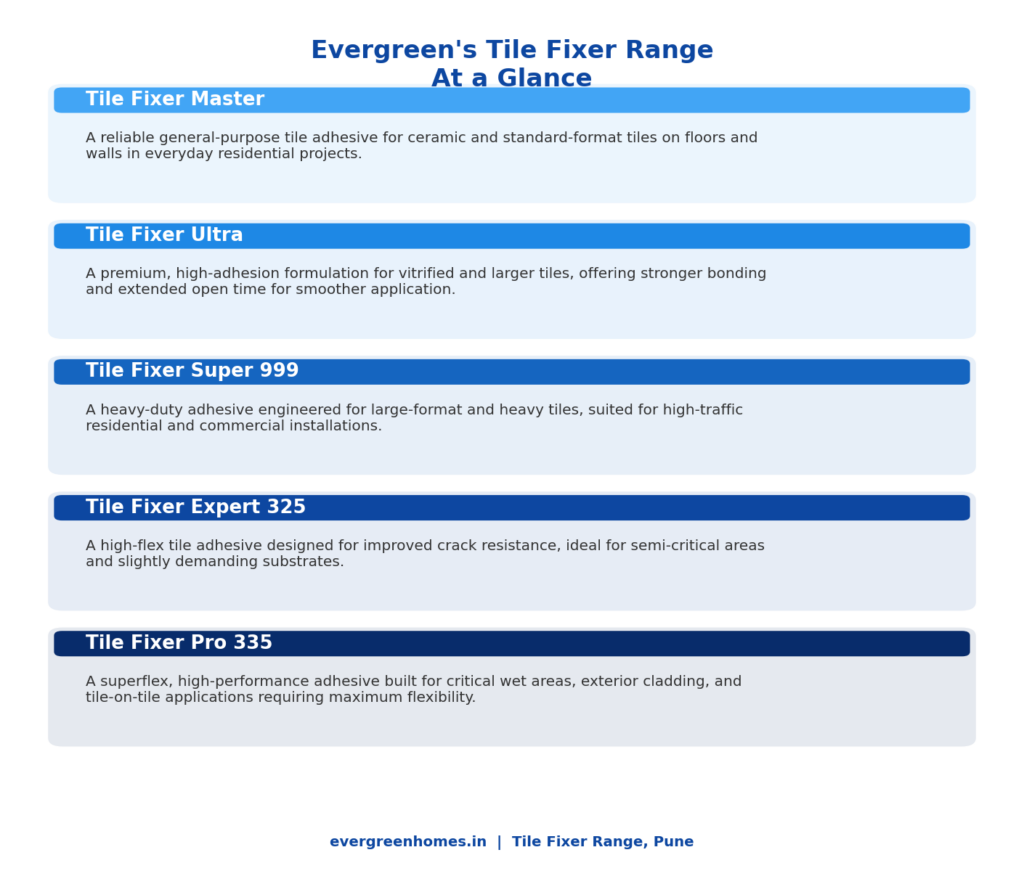
A reliable, general-purpose tile adhesive for ceramic and standard-format tiles, well suited to everyday residential floor and wall tiling.
Tile Fixer Ultra
A premium, high-adhesion formulation built for vitrified and larger tiles, offering stronger bonding and a longer open time for a smoother, more precise application.
Tile Fixer Super 999
A heavy-duty adhesive engineered for large-format and heavy tiles, ideal for high-traffic residential and commercial installations that demand extra holding strength.
Tile Fixer Expert 325
A high-flex tile adhesive formulated for improved crack resistance, well suited to semi-critical areas and slightly demanding or uneven substrates.
Tile Fixer Pro 335
Evergreen’s superflex, high-performance adhesive designed for critical wet areas, exterior cladding, and tile-on-tile applications where maximum flexibility and bond strength are essential.
Explore Evergreen's Tiling Solutions
Evergreen Enterprises offers a complete range of high-performance tile adhesives designed for vitrified tiles, wet areas, large-format installations, and exterior cladding — trusted by contractors and homeowners across Pune.
📞 Contact us today at 7768996699 / 7768993399 or explore our Tiling Solutions range to find the right adhesive for your next project.
Related Reading
-
Internal: Common Grouting Problems and How to Avoid Them — evergreenhomes.in/blog
-
Internal: Ready Mix Cement Plaster: A Complete Guide for Builders and Contractors — evergreenhomes.in/blog
Tile Adhesive vs Cement Mortar — Cost, Time & Durability Comparison