
India is entering the most capital-intensive infrastructure cycle in its history — backed by a ₹12.2 lakh crore capital expenditure outlay for 2026-27 and a construction sector racing to keep pace with urbanisation. But the bigger story isn’t just how much India is building — it’s how differently it will build. Between now and 2030, robotics, AI, and next-generation materials will move from pilot projects to standard practice on Indian job sites. Here are the 10 technologies and materials every builder, contractor, and homeowner should have on their radar.
10 Technologies & Materials Shaping India's Construction Future
|
1 |
Modular & Prefabricated Construction [Construction Method] Off-site production of walls, bathroom pods, and façade panels cuts build time, waste, and site labour dependency — ideal for tight urban timelines. |
|
2 |
3D-Printed Concrete Structures [Materials & Method] Layer-by-layer concrete extrusion is moving from pilot projects to real affordable-housing builds, printing walls and structural elements with far less labour and waste. |
|
3 |
Robotics & Site Automation [Automation] Drones for site surveys, robotic bricklayers, and autonomous machinery are easing labour shortages while improving precision and jobsite safety. |
|
4 |
Digital Twins & BIM Integration [Digital Tools] Virtual replicas of buildings let teams simulate performance, catch clashes, and plan scenarios before construction starts — cutting costly rework. |
|
5 |
Low-Carbon & Green Concrete [Materials] Concrete made with recycled aggregates, reduced cement content, or alternative binders delivers comparable strength with a much smaller carbon footprint. |
|
6 |
Sensor-Embedded Smart Materials [Smart Materials] IoT sensors and conductive fibres embedded in structural elements track load, vibration, and humidity — flagging maintenance needs before problems appear. |
|
7 |
AR & Wearables for Site Safety [Safety Tech] Augmented-reality headsets and biometric wearables help workers visualise hazards, follow real-time instructions, and get fatigue alerts on-site. |
|
8 |
Advanced Curing Technologies [Construction Method] Spray-on curing compounds and micro-encapsulated curing agents conserve water while speeding up strength gain and formwork turnaround. |
|
9 |
AI-Driven Project Management [Digital Tools] Machine learning tools now forecast delays, cost overruns, and resource gaps — helping firms manage multi-site portfolios with real-time dashboards. |
|
10 |
Self-Healing & Energy-Generating Materials [Materials] Bacteria-based self-healing concrete and solar-integrated façades are moving from labs to pilot infrastructure projects, extending structure life and cutting maintenance. |
Quick Takeaways
- India’s ₹12.2 lakh crore 2026-27 capex outlay is accelerating tech adoption across the construction value chain.
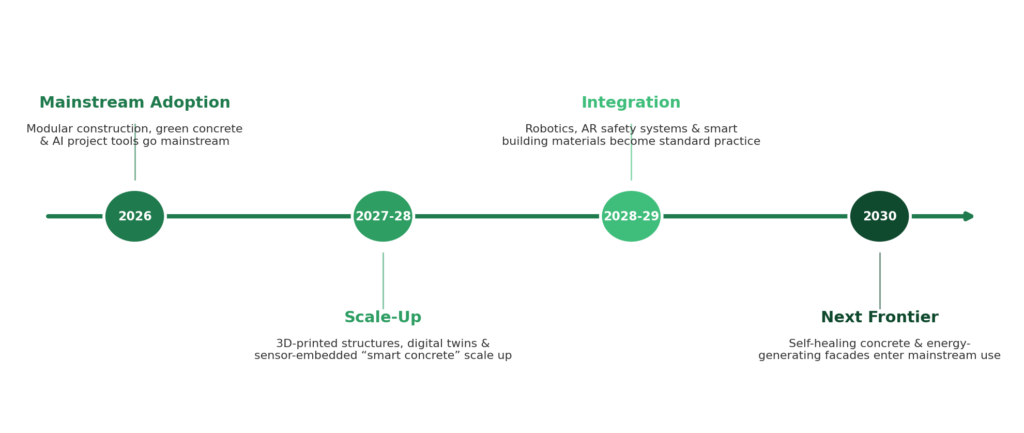
- Modular construction, green concrete, and AI project tools are expected to go mainstream first, by 2026.
- 3D printing, digital twins, and sensor-embedded materials are scaling through 2027-28.
- Self-healing concrete and energy-generating façades represent the next frontier heading into 2030.
- Builders who adopt these trends early gain an edge on cost, speed, and long-term durability.
Conclusion
With the right construction materials, every project can achieve better durability, efficiency, and performance. Evergreen Homes provides dependable solutions to support both modern and traditional construction needs.