
Walk onto almost any construction site in India today — from a mid-size apartment project in Pune to a metro station in Mumbai — and you will notice a quiet but significant shift. Cement-sand mortar, once the default for fixing tiles, is steadily being replaced by tile adhesive. This change hasn’t happened overnight, but in the last few years tile adhesive usage in the Indian construction industry has risen sharply, and contractors, builders and homeowners all want to know why.
Why Is Tile Adhesive Usage Suddenly Increasing in India?
Several forces are converging at once, and together they explain the jump in demand.
1. Rapid Urbanization and the Real Estate Boom
India’s cities are expanding faster than ever, and residential and commercial construction has scaled up to match. Every new apartment, office and retail space needs floor and wall tiling. With project timelines under constant pressure, builders choose materials that speed up execution, which is exactly what they delivers over traditional mortar.
2. The Shift Away from Traditional Cement Mortar
Cement-sand mortar depends heavily on the mason’s skill, needs a thick bed and is prone to hollow patches and tile pop-outs over time. Tile adhesive is a factory-controlled, polymer-modified formulation that bonds consistently regardless of who applies it. That reliability alone is pushing more contractors to switch. You can read a detailed comparison in our guide on tile adhesive vs cement for tile installation.
3. Rise of Vitrified and Large-Format Tiles
Homeowners now prefer large-format vitrified and porcelain tiles for their seamless, premium look. These tiles have very low water absorption, so ordinary cement mortar simply cannot create a durable bond with them. Vitrified tile adhesive, with its high bonding strength, has become non-negotiable for this category.
4. Government Push Through PMAY and Smart Cities
Large housing and infrastructure programmes such as Pradhan Mantri Awas Yojana – Urban and the Smart Cities Mission have accelerated construction across hundreds of cities. Projects executed at this scale rely on quality-consistent materials, tile adhesive among them, to meet deadlines without compromising finish.
5. Faster Installation and Lower Labour Dependency
With skilled mason availability shrinking in many regions, tile adhesive is attractive because it needs a thinner bed, cures faster and lets tiles be walked on and grouted sooner. That cuts overall project time significantly compared with conventional mortar fixing.
Market Data: How Big Is India's Tile Adhesive Boom?
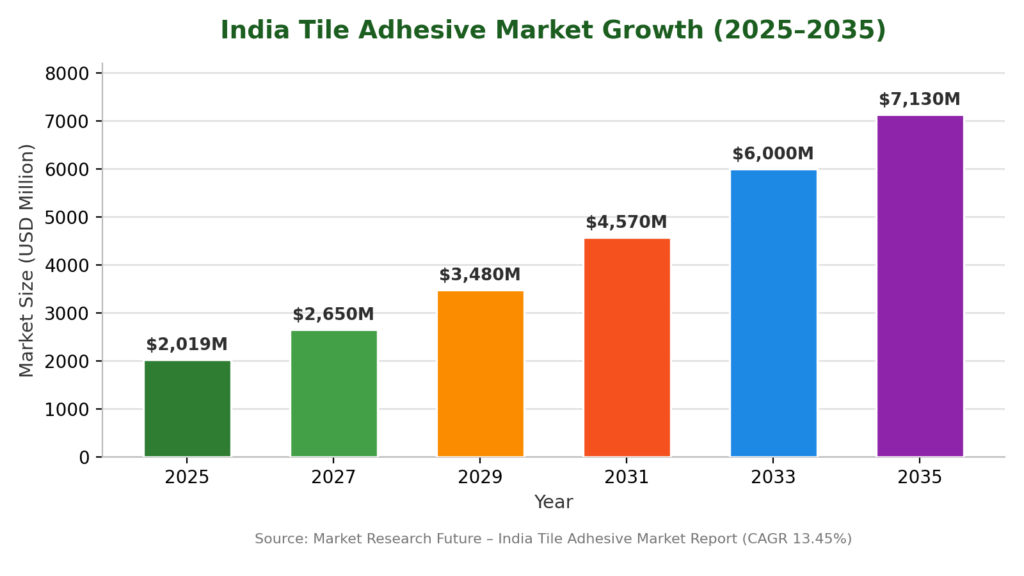
According to Market Research Future’s India tile adhesive market report, the Indian market is projected to grow at a CAGR of about 13.45% between 2025 and 2035, rising from roughly USD 2,019 million to nearly USD 7,130 million. The chart below shows how steep the curve is (intermediate years are interpolated from the report’s start and end values).
Types of Tile Adhesive Used on Indian Sites
Not every job needs the same product. The Indian standard for tile adhesives, IS 15477, published by the Bureau of Indian Standards, groups adhesives by performance. In practice, sites use three broad categories.
Standard Cementitious Adhesive
Suitable for small ceramic wall and floor on well-prepared interior surfaces.
Polymer-Modified Adhesive
The workhorse for vitrified and porcelain tiles, with stronger grip and better open time.
Flexible and High-Performance Adhesive
Used for large-format tiles, natural stone, façades and areas that see heat, moisture or movement.
Common Mistakes That Waste the Benefits of Tile Adhesive
-
Fixing on a Dusty or Weak Surface
The substrate must be clean, sound and free of oil, dust and loose particles.
-
Ignoring Open Time and Back-Buttering
Spread only as much adhesive as you can tile before it skins over, and back-butter large tiles for full coverage.
Tile Adhesive vs Cement Mortar: Why Builders Are Switching
- Bonding strength: polymer-modified adhesive bonds far better with vitrified and large-format tiles.
- Application thickness: adhesive needs a thin bed of roughly 3–6 mm compared with 15–20 mm of mortar, saving material and dead load.
- Speed: adhesive-fixed tiles can typically be grouted within about 24 hours, versus longer curing for mortar beds.
- Consistency: a factory-controlled formulation removes the guesswork of manual sand-cement ratios.
- Wastage: pre-mixed powder reduces on-site material wastage.
Evergreen Homes: A Trusted Tile Adhesive Supplier in Pune
At Evergreen Enterprises, we supply a complete range of tile adhesives built for Indian site conditions
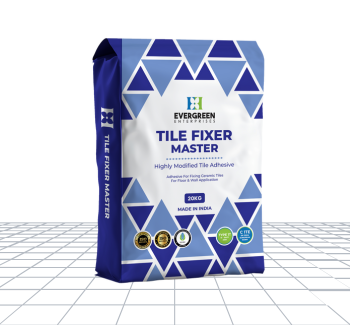
Tile-Fixer-Master is a high-performance tile adhesive designed for strong, durable, and reliable tile installation.
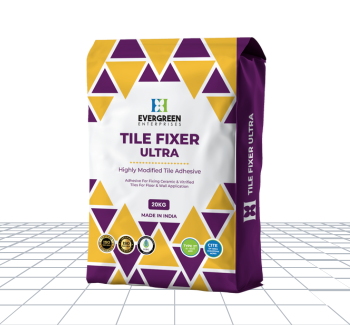
Tile Fixer Ultra is a high-strength tile adhesive designed for durable, reliable, and long-lasting tile installation.
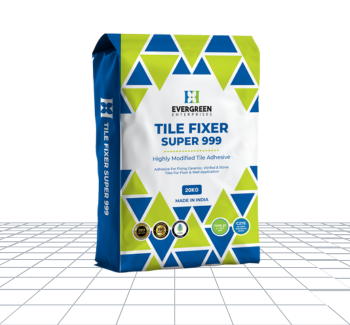
Tile Fixer Super 999 is a premium tile adhesive formulated for strong bonding, easy application, and long-lasting tile installation.
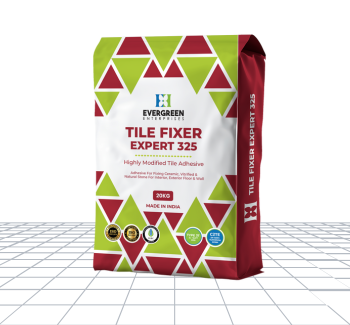
Tile Fixer Expert 325 is a dependable tile adhesive offering excellent bonding strength and lasting performance for tile installation.
Frequently Asked Questions
Q – Is tile adhesive better than cement for tile fixing?
– For most modern tiles, yes. The adhesive gives a stronger and more consistent bond, needs a thinner bed and speeds up installation. Cement mortar can still work for highly absorbent tiles on simple interior floors, but it is unreliable for vitrified and large-format tiles.
Q – Why has tile adhesive demand grown so quickly in India?
– Demand has risen because of urbanization, bigger vitrified tiles, government housing programmes, and a shortage of skilled masons. Builders want faster, more reliable methods, and adhesive delivers on both counts.
Q – Can tile adhesive be used on AAC block walls?
– Yes, provided the surface is clean, sound and properly plastered or prepared. Follow the manufacturer’s instructions on priming and application to ensure a durable bond.
Conclusion
The sudden rise in tile adhesive usage across India is not a passing trend. It is a direct response to faster timelines, bigger tiles, government-backed housing and a real need for long-lasting bonding. As the market heads toward USD 7 billion by 2035, choosing a reliable adhesive supplier matters more than ever.
Build Strong. Build Green. Build with Evergreen